Comprehensive vs. Collision Car Insurance Explained

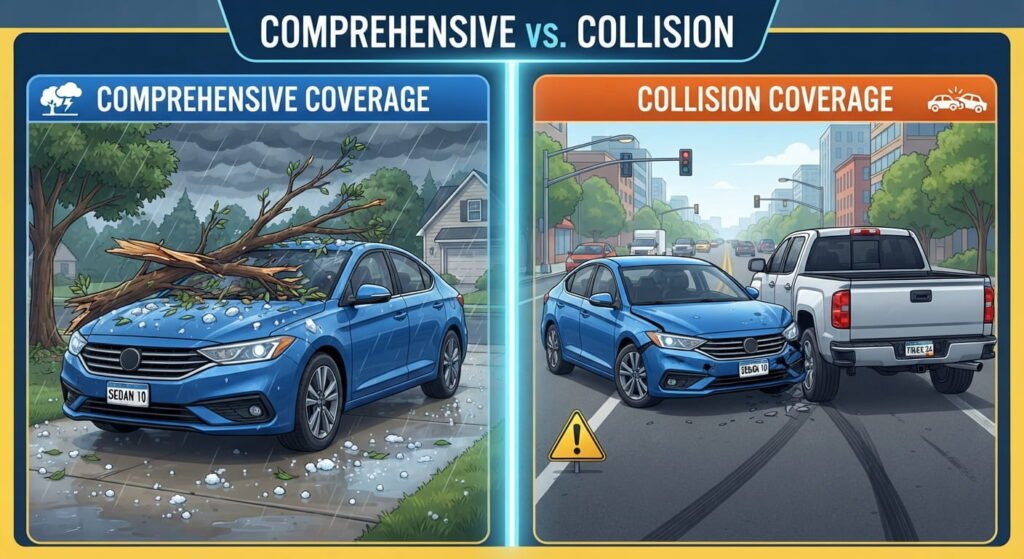
Understanding comprehensive vs. collision car insurance matters because both cover damage to your own vehicle, but they generally apply to very different events. Collision coverage is typically for damage caused by a crash with another vehicle or object. Comprehensive coverage is generally for covered non-collision losses, such as theft, hail, vandalism, fire, flooding, falling objects, or striking an animal.
Choosing the right combination can affect how much you pay for repairs, how much you owe out of pocket after a claim, and whether you can afford to replace your vehicle after a major loss. Neither coverage replaces liability insurance, which generally pays for covered injuries or property damage you cause to others.
This guide explains what comprehensive and collision coverage do, how deductibles work, when each coverage may make sense, and what to consider before adding, keeping, or dropping either option.
What is comprehensive car insurance?
Comprehensive coverage, sometimes called “other-than-collision” coverage, generally helps pay to repair or replace your vehicle after a covered event that is not a collision with another vehicle or object. It applies subject to the policy’s deductible, exclusions, vehicle value, and other conditions.
Common events that comprehensive car insurance may cover include:
- Vehicle theft or theft-related damage
- Vandalism or riot damage
- Hail, wind, lightning, and certain other storm losses
- Fire
- Flooding, subject to policy terms
- Falling objects, such as a tree branch, ice, or debris
- Broken windshield or other glass damage, depending on policy and state rules
- Damage from striking an animal, such as a deer
For example, imagine that a hailstorm dents the hood, roof, and trunk of your parked car. Comprehensive coverage may help pay for covered repairs after you pay the applicable deductible. Or, if a deer runs into the road and you strike it, comprehensive coverage generally handles the vehicle damage because the loss involves an animal rather than a collision with another vehicle or stationary object.
Comprehensive coverage is not a maintenance plan. It generally does not pay for routine repairs, worn tires, engine failure, oil changes, gradual deterioration, or every weather-related loss. The exact scope of coverage depends on the policy language.
It is typically optional under state law. However, if you finance or lease your car, a lender or lessor commonly requires comprehensive coverage, usually alongside collision coverage, to protect its financial interest in the vehicle.
What is collision car insurance?
Collision coverage generally helps pay for covered physical damage to your own vehicle when it is involved in a crash with another vehicle or object. It can apply regardless of who caused the accident, though you usually pay your deductible first and policy conditions still apply.
Collision coverage may apply when you:
- Hit another vehicle
- Back into a parked car
- Strike a tree, fence, guardrail, mailbox, pole, or building
- Crash into a curb or pothole
- Lose control in a single-car accident
- Roll over your vehicle
For example, suppose you skid on wet pavement, hit a guardrail, and cause $6,000 in damage to your vehicle. If you have collision coverage with a $1,000 deductible, the insurer may pay up to $5,000 of the covered repair amount, subject to the policy terms and the vehicle’s value.
Collision coverage usually does not pay for injuries to you or your passengers, damage to someone else’s vehicle, or damage to another person’s property. Those losses may fall under liability, medical payments, personal injury protection, uninsured motorist, or other coverage types, depending on the accident and state law.
Collision also does not generally cover theft, vandalism, hail, fire, or a falling tree branch. Those losses are commonly handled under comprehensive coverage. The Insurance Information Institute describes collision coverage as protection for damage resulting from a collision with an object, including a telephone pole, guardrail, mailbox, or vehicle rollover.
Like comprehensive coverage, collision is usually not mandated by state law. A lender or leasing company, however, commonly requires it for a financed or leased vehicle.
Comprehensive vs. collision car insurance: Key differences
| Feature | Comprehensive Coverage | Collision Coverage |
|---|---|---|
| Main purpose | Helps cover certain non-collision damage to your own vehicle | Helps cover crash-related damage to your own vehicle |
| Typical covered incidents | Theft, vandalism, fire, hail, flood, falling objects, animal strikes | Crashes with another vehicle, object, curb, pothole, guardrail, tree, or pole; rollovers |
| Theft protection | Generally yes, subject to policy terms | Generally no |
| Weather-related damage | Generally yes for covered events such as hail, flood, or wind damage | Generally no |
| Damage from hitting another vehicle | Generally no | Generally yes |
| Single-vehicle accident | Usually no, unless caused by a covered non-collision event | Generally yes |
| Deductibles | Usually has its own deductible | Usually has its own deductible |
| Required by state law | Generally no | Generally no |
| Lender or lease requirement | Often required for financed or leased vehicles | Often required for financed or leased vehicles |
The difference between comprehensive and collision insurance is the cause of the damage. Comprehensive generally applies when something other than a crash damages your car. Collision generally applies when your car hits, or is hit by, another vehicle or physical object.
Many drivers buy both coverages together. They are often grouped informally with liability coverage under the phrase “full coverage car insurance,” but “full coverage” is not a standardized policy and does not mean every loss is covered.
Real-life examples: When does each coverage apply?
Example 1: A hailstorm damages your car
Your vehicle is parked outside during a severe hailstorm. The hood, roof, and windshield are damaged.
Comprehensive coverage may help pay for covered hail damage after your deductible. If the repair bill is lower than your deductible, however, the insurer may not make a payment. Glass coverage rules and deductibles can differ by insurer and state.
Example 2: You hit another vehicle
You rear-end another car at a stoplight. Your front bumper and headlights are damaged, and the other driver’s vehicle is damaged.
Collision coverage may help pay for covered damage to your own car, after your collision deductible. Your liability coverage may help address covered damage or injuries you caused to the other driver, up to your policy limits. Collision does not replace liability coverage.
Example 3: Your car is stolen
You wake up and discover that your vehicle is gone from your driveway. Police later recover it with damage, or it is not recovered.
Comprehensive coverage may help with a covered theft claim, typically based on the vehicle’s actual cash value minus the deductible. The exact payment depends on the policy, documentation, vehicle value, and claim investigation.geico
Example 4: You hit a tree or pole
You swerve to avoid debris and hit a tree. Your car’s front end is damaged.
Collision coverage may help pay for covered repairs, after the deductible. Even though the tree was stationary and no other driver was involved, striking it is generally considered a collision loss.
How do deductibles work for comprehensive and collision insurance?
A deductible is the amount you generally pay toward a covered claim before the insurer pays the remaining covered amount. Comprehensive and collision coverage usually have separate deductibles, so you may choose different amounts for each.
Here is a simple example:
| Claim item | Amount |
|---|---|
| Covered repair cost | $3,000 |
| Collision or comprehensive deductible | $500 |
| Potential insurer payment | $2,500 |
This calculation assumes the entire $3,000 repair is covered, the damage does not exceed the vehicle’s value, and no other claim adjustment applies. Real claims may involve depreciation, actual cash value, prior damage, policy limits, repair estimates, and other policy conditions.
A higher deductible may lower your premium, but it increases the amount you would need to pay after a covered accident, theft, hailstorm, or other loss. A lower deductible generally means more protection from immediate out-of-pocket costs, but it may increase the premium.
Before selecting a deductible, consider:
- Your emergency savings
- Your vehicle’s current market value
- The annual difference in premium between deductible choices
- Your ability to pay the deductible quickly after a loss
- Whether the vehicle is financed or leased, since the lender may impose deductible limits
Separate deductibles are common. For example, you might choose a $500 comprehensive deductible and a $1,000 collision deductible, but the available choices depend on the insurer and policy.
Do you need both comprehensive and collision coverage?
Whether you need comprehensive and collision coverage depends on the vehicle, your finances, and any loan or lease requirements. Neither coverage is automatically right for every driver.
Having both may make sense if you own:
- A newer vehicle
- A vehicle with a high market value
- A financed or leased car
- A car you could not easily repair or replace after a major loss
- A vehicle exposed to theft, hail, flooding, animal strikes, or high traffic risks
For a financed or leased vehicle, the decision may not be optional. Loan and lease contracts commonly require collision and comprehensive coverage until the obligation ends. If required coverage is removed, a lender may purchase force-placed or single-interest coverage that protects the lender—not necessarily you—and charge the cost to your loan account.
Owners of older vehicles may decide to reconsider one or both coverages when the vehicle has depreciated significantly. However, age alone should not make the decision. Compare the car’s current market value with:
- The annual cost of comprehensive and collision
- The deductibles
- The likely insurance payment after a total loss
- The risk of theft, severe weather, animals, or a crash
- Your ability to repair or replace the vehicle without insurance proceeds
Dropping coverage means you would be responsible for repairing or replacing your own vehicle after a covered loss. Review your policy and loan agreement before making changes.
How much do comprehensive and collision coverage cost?
Comprehensive and collision premiums depend on the driver, vehicle, location, and insurer. They may be listed as separate items on your declarations page, though formatting varies among insurers.
Pricing can be affected by:
- Vehicle make, model, age, trim, and actual cash value
- Repair costs, parts availability, safety technology, and theft risk
- Your ZIP code and local weather, theft, accident, and vandalism patterns
- Driving history and previous claims
- Chosen deductibles
- Annual mileage and how you use the vehicle
- Insurer-specific underwriting rules and legally permitted rating factors
The Insurance Information Institute has reported that the average annual cost of comprehensive coverage was a little over $134 in the data it cites, but that figure is historical market context rather than a 2026 personalized quote. It should not be treated as the expected price for a particular driver, car, or state.iii
For an accurate comparison, request personalized quotes using identical coverage limits and deductible choices. Review both the premium and the protection you would receive after a loss.
Common mistakes to avoid
Avoid assuming comprehensive coverage protects against every type of vehicle damage. It does not generally cover mechanical breakdowns, wear and tear, maintenance, or all losses.
Do not assume collision coverage pays every accident-related bill. It generally addresses damage to your own vehicle, not the other driver’s injuries or property damage. Liability coverage serves a different purpose.
Other mistakes include:
- Confusing liability insurance with physical-damage coverage
- Choosing a deductible that is difficult to pay
- Dropping required coverage without checking a loan or lease agreement
- Treating “full coverage” as a guarantee against every possible loss
- Ignoring exclusions, payment limits, and claim conditions
- Selecting a policy based on premium alone
Read the declarations page and policy documents. Ask an insurer or agent what each coverage includes, which deductible applies, and how a specific hypothetical loss would normally be handled.
Frequently asked questions
Is comprehensive or collision insurance required by law?
Generally, no. State laws usually require liability insurance or another form of financial responsibility, not comprehensive or collision coverage. However, lenders and leasing companies commonly require both coverages when a vehicle is financed or leased. Check your state rules and loan or lease contract.progressive
Does comprehensive insurance cover hitting a deer?
Generally, yes. Damage from striking an animal, such as a deer, is commonly handled under comprehensive coverage rather than collision coverage. The claim remains subject to your deductible, policy terms, exclusions, and claim review.
Does collision insurance cover damage if I am at fault?
Generally, collision coverage can help pay for covered damage to your own vehicle after a crash, even if you caused it. You normally pay the collision deductible, and the policy’s limits and conditions apply. Damage or injuries you caused to others are generally addressed through liability coverage.
Can I have comprehensive insurance without collision coverage?
Possibly, but available coverage combinations depend on the insurer, vehicle, state, and policy rules. A lender or lessor may require both coverages, so do not remove collision or comprehensive coverage without reviewing your contract first.
Should I drop collision coverage on an older car?
Consider the vehicle’s market value, annual collision premium, deductible, risk of an accident, and your ability to replace or repair the car. If a potential claim payment would be small relative to what you pay for coverage and your deductible, it may be worth reassessing. But dropping coverage means accepting the financial risk yourself.
Does comprehensive or collision insurance cover mechanical breakdowns?
Usually not. Standard comprehensive and collision coverage generally do not pay for routine maintenance, mechanical failure, normal wear and tear, or defective parts. A manufacturer warranty, extended warranty, or mechanical-breakdown policy may address some of those issues, depending on its terms.
Conclusion
The core difference in comprehensive vs. collision car insurance is the type of event causing the damage. Comprehensive coverage generally applies to covered non-collision losses such as theft, hail, fire, vandalism, falling objects, floods, and animal strikes. Collision coverage generally applies when your vehicle collides with another vehicle or object.
The right decision depends on your car’s value, deductible budget, loan or lease obligations, local risks, and ability to pay for repairs or replacement yourself. Review your policy terms carefully, compare quotes using equivalent deductibles, and confirm lender requirements before changing coverage. Take a few minutes to review your existing declarations page or request personalized quotes to see whether your protection still fits your vehicle and budget.