Car Insurance for Beginners: First-Time Buyer Guide

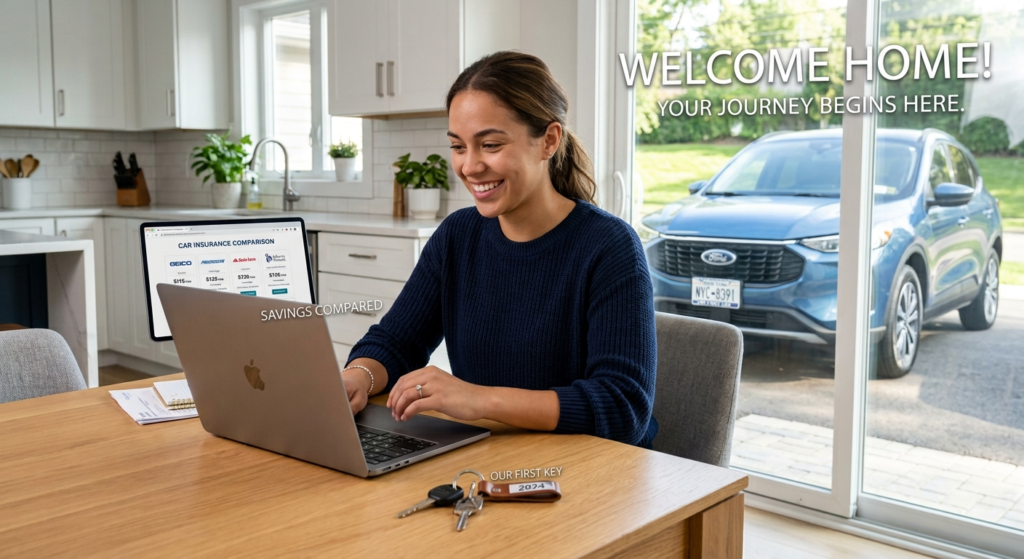
Buying your first auto policy can feel intimidating. You may see unfamiliar terms such as liability limits, deductibles, comprehensive coverage, and uninsured motorist protection—then find very different prices for what appears to be the same car.
This guide to car insurance for beginners is designed to make those choices easier. In the United States, car insurance requirements and policy options vary by state, while premiums can vary based on your age, experience, ZIP code, vehicle, driving history, mileage, and selected coverage. Understanding the basics before you shop can help you avoid paying for coverage you do not need—or, more importantly, buying too little protection for a serious accident.
Below, you will learn how car insurance works, which coverage types matter, how to compare quotes, what affects first-time car insurance costs, and common mistakes to avoid before purchasing your first policy.
What is car insurance and how does it work?
Car insurance is a contract between you and an insurance company. You pay a premium—usually monthly, every six months, or annually—and the insurer agrees to help pay certain covered losses under the policy’s terms, limits, exclusions, and conditions.
The main parts of a policy are:
- Premium: The price you pay to keep the insurance active.
- Coverage: The types of losses the policy may help pay for.
- Deductible: The amount you pay yourself for certain covered claims before the insurer pays the remaining covered amount.
- Policy limit: The maximum amount the insurer will pay for a particular coverage or claim, subject to the policy terms.
- Claim: A request for payment after an accident, theft, weather loss, or another covered event.
- Policyholder: The person who owns the insurance policy.
For example, suppose your car has $4,000 in covered collision damage and you chose a $500 collision deductible. You would generally pay the first $500, and the insurer could pay the remaining covered $3,500, assuming the loss is covered and no other policy condition limits payment.
Insurance does not automatically pay for every repair, accident, personal item, or mechanical problem. What is covered depends on the policy language, the facts of the loss, exclusions, deductibles, and selected limits.
Types of car insurance coverage every beginner should know
Liability insurance
Liability insurance helps pay for covered injuries or property damage you cause to other people in an accident. It usually has two main parts:
- Bodily injury liability may help pay for another person’s medical bills, lost income, pain and suffering, or legal defense costs when you are legally responsible for the accident.
- Property damage liability may help pay to repair or replace another person’s vehicle, fence, building, mailbox, or other damaged property.
Most states require drivers to carry at least a minimum amount of liability coverage or otherwise meet financial-responsibility rules. The required limits vary by state. For example, Illinois requires at least $25,000 per person and $50,000 per accident for bodily injury liability, plus $20,000 for property damage liability.idoi.illinois
State minimums are legal starting points, not necessarily enough protection for a severe crash. If damages exceed your liability limit, you may be personally responsible for the difference.
Collision coverage
Collision coverage generally helps pay for damage to your own car after it collides with another vehicle, a tree, a guardrail, a pothole, or another object. It generally applies regardless of who caused the crash, subject to your deductible and policy terms.
For example, if you hit a parked car or slide into a utility pole, collision coverage may help pay for your vehicle’s repairs after you pay the applicable deductible.
Collision is usually optional under state law, but a lender or leasing company may require it if you finance or lease your vehicle. Massachusetts’ insurance guidance notes that borrowers may be required to carry collision and comprehensive coverage when a car has a loan.mass
Comprehensive coverage
Comprehensive coverage—sometimes called “other than collision” coverage—generally protects your own car against certain non-collision losses. Covered events may include theft, vandalism, hail, falling objects, fire, flooding, windshield damage, and damage caused by an animal such as a deer.
For example, if a tree branch falls on your parked car during a storm, comprehensive coverage may help pay for the damage after the deductible, assuming the event is covered by the policy.
Comprehensive coverage is not a maintenance plan. It generally does not cover wear and tear, mechanical breakdowns, routine maintenance, or every possible form of vehicle damage. Read your policy and ask your insurer about exclusions.
Uninsured and underinsured motorist coverage
Uninsured motorist coverage may help if you are injured or your vehicle is damaged by a driver who has no insurance or cannot be identified, such as in some hit-and-run situations. Underinsured motorist coverage may help when the at-fault driver has insurance, but not enough liability coverage to pay covered losses.
Availability, minimum limits, and requirements vary by state. Illinois, for example, requires uninsured motorist bodily injury coverage with minimum limits of $25,000 per person and $50,000 per accident.idoi.illinois
This coverage can be particularly important because auto liability insurance is compulsory in 49 states and Washington, D.C., but drivers may still encounter uninsured or underinsured motorists. New Hampshire does not have a compulsory auto liability insurance law, although drivers there must comply with alternative financial-responsibility requirements.naic
Personal injury protection and medical payments coverage
Personal injury protection, or PIP, can help pay certain medical expenses after a car accident regardless of who caused it. Depending on state rules and policy terms, it may also help with a portion of lost wages or essential services.
Medical payments coverage, often called MedPay, may also help cover eligible medical expenses for you and your passengers after an accident. It generally has different rules and benefits than PIP.
PIP requirements vary widely by state. In Massachusetts, for instance, PIP can cover medical expenses, a portion of lost wages, and replacement services up to the applicable policy limit, regardless of fault.mass
The simple distinction is this: legally required coverage is what your state requires to drive or register a vehicle legally. Optional coverage is protection you choose based on your vehicle, finances, lender requirements, and personal risk tolerance.
How much car insurance do first-time buyers need?
There is no single first-time car insurance package that works for everyone. Your coverage needs depend on where you live, what you drive, how much you drive, and what you could afford to pay after an accident.
Start by checking your state’s minimum liability and financial-responsibility requirements. Then consider whether those limits would be sufficient if you caused a serious crash involving injuries, multiple vehicles, or expensive property damage. State minimums may be too low to cover all potential losses.
Also evaluate:
- Your vehicle’s current value and likely repair cost
- Whether your car is financed or leased
- Your savings and ability to pay a deductible
- Your income, assets, and potential financial exposure after an at-fault accident
- Whether you regularly drive in areas with heavier traffic, severe weather, or uninsured-driver risk
- Your annual mileage and how you use the vehicle
Collision and comprehensive coverage can be especially useful for a newer, financed, leased, or higher-value vehicle. If you own an older car outright, compare the annual cost of these coverages and the deductible against the vehicle’s market value and your ability to replace it after a total loss.
Do not automatically choose the lowest quote. A policy with higher liability limits and a manageable deductible may provide substantially better financial protection than bare-minimum coverage.
How much does car insurance cost for beginners?
First-time buyers should expect quotes to vary substantially. Younger drivers and newly licensed drivers may pay more because insurers have less driving experience to evaluate, but age alone does not determine your premium.
Your price can be affected by:
- Age and years licensed
- State, city, and ZIP code
- Vehicle make, model, trim, safety features, theft risk, and repair costs
- Driving record, prior claims, and traffic violations
- Annual mileage and commuting or business use
- Liability limits, collision and comprehensive coverage, and deductibles
- Insurer-specific underwriting and discount rules
- Credit-based insurance information where state law allows its use
The latest nationwide NAIC reporting available for market context is based on 2023 data, not individualized 2026 quotes. The NAIC reported that nationwide average expenditures rose to $1,281.60 in 2023, while combined average premiums rose 14.41 percent. Those figures cover broad insurance-market data and should not be treated as the expected cost of a first policy.naic
The most useful number is a personalized quote based on your actual vehicle, address, coverage limits, and driver profile.
How to buy car insurance for the first time
1. Gather your information
Before requesting quotes, collect the details insurers commonly need:
- Driver’s license number and date first licensed
- Full legal name, date of birth, and home address
- Vehicle identification number, or VIN
- Vehicle year, make, model, trim, and ownership status
- Estimated annual mileage and primary vehicle use
- Recent driving history, tickets, accidents, and claims
- Information about other household drivers and vehicles
Using the VIN produces a more accurate quote than relying only on the vehicle model. Massachusetts’ consumer guidance specifically recommends using each vehicle’s VIN, as well as the licensed drivers’ names, license numbers, and first-license dates.mass
2. Decide which coverage you need
Review your state’s required minimum coverage first. Next, consider whether you need collision and comprehensive because of a loan or lease, your vehicle’s value, and your financial situation.
Choose liability limits thoughtfully. Consider uninsured or underinsured motorist protection, medical coverage, rental reimbursement, roadside assistance, and other optional features only after understanding their cost and usefulness.
3. Compare multiple quotes
Request quotes from at least three insurers. Use identical liability limits, deductibles, drivers, vehicles, mileage estimates, and optional coverage choices. Otherwise, you are comparing different policies rather than different prices.
The NAIC recommends comparing deductibles and coverage details alongside premiums.content.naic
4. Ask about discounts
Ask each insurer about discounts you may legitimately qualify for. Depending on the company and state, possibilities can include good-student, defensive-driving, multi-car, bundling, safety-equipment, paperless, autopay, low-mileage, and safe-driving-program discounts.
Eligibility and savings vary, so ask for a complete discount review rather than assuming a discount is included.
5. Review the policy details
Before purchasing, read the quote and policy documents carefully. Confirm deductibles, liability limits, named drivers, excluded drivers, vehicle usage, payment schedule, cancellation terms, and any exclusions.
Ask questions about anything you do not understand. It is easier to correct an error before the policy begins than after a claim.
6. Purchase the policy and confirm coverage
Confirm the exact effective date and time. If insurance is required before you can drive, register, finance, or take delivery of the vehicle, make sure the policy is active before you drive.
A new insurer may issue a binder as temporary proof of insurance. Pennsylvania notes that a binder can serve as temporary proof of a newly created policy for 30 or 60 days.pa
7. Keep documents accessible
Save your insurance ID card digitally and keep a physical copy if your state or personal preference calls for one. Keep your declarations page and insurer contact information accessible, and know how to report a claim after an accident.
How to find affordable car insurance as a first-time buyer
Affordable auto insurance for beginners is usually the result of careful shopping rather than one shortcut. Start by comparing multiple quotes with matching coverage. A lower quote is only useful if it provides the limits and protections you need.
Other practical steps include:
- Ask every insurer to review potential discounts.
- Consider staying on a family policy when you are eligible and it makes financial and practical sense.
- Compare different deductibles, but choose one you can pay from savings.
- Explore telematics or safe-driving programs if you are comfortable with driving-data collection and the program’s renewal rules.
- Choose a vehicle with reasonable repair, replacement, and insurance costs before buying.
- Ask whether low-mileage pricing or a pay-per-mile option is available if you drive very little.
- Maintain a clean driving record and avoid letting coverage lapse.
- Review your policy and premiums at each renewal.
The cheapest advertised policy may have a high deductible, minimal liability limits, limited optional protections, or payment-plan fees. Focus on value: enough coverage for your risks at a premium you can sustain.
Common car insurance mistakes first-time buyers should avoid
First, do not buy based on price alone. A low price can come from low liability limits, high deductibles, or missing coverage. Compare the entire policy.
Second, do not confuse liability-only insurance with “full coverage.” Liability generally protects others from damage you cause, while full coverage commonly describes a combination of liability, collision, and comprehensive coverage. It is not a standardized policy name.
Third, pay attention to deductibles. A $1,000 deductible may lower a premium but can be difficult to manage immediately after a crash or theft.
Fourth, disclose household drivers, vehicle ownership, garaging address, estimated mileage, commuting, delivery, rideshare, or business use accurately. Incorrect information can create claim and coverage problems.
Also avoid assuming every type of damage is covered. Personal belongings may be covered under homeowners or renters insurance rather than auto insurance, and routine mechanical failures are generally not covered. Do not overlook lender or lease requirements, miss payment deadlines, allow coverage to lapse, or skip the renewal review.
Frequently asked questions
What is the best car insurance for first-time buyers?
The best first-time car insurance depends on your state, vehicle, coverage needs, budget, driving history, service preferences, and discount eligibility. Compare several insurers using identical coverage settings. Consider price, claims access, financial strength, digital tools, and agent availability—not just the lowest premium.
Can I get car insurance before buying a car?
Yes. You can usually request quotes before buying a vehicle. To bind or activate a policy, insurers generally need specific driver and vehicle information, including the VIN, ownership details, garaging address, and effective date. Arrange coverage before driving the car home.
Is car insurance mandatory in the USA?
In most places, yes. The NAIC states that 49 states and Washington, D.C., require auto liability insurance before drivers can legally operate a vehicle, although coverage types and required amounts differ. New Hampshire uses an alternative financial-responsibility approach instead of a compulsory liability-insurance law.naic
What is the difference between liability and full coverage?
Liability coverage helps pay covered injuries and property damage you cause to other people. “Full coverage” is an informal term, typically referring to liability coverage plus collision and comprehensive coverage for your own vehicle. It is not a universal insurance product, and exact coverage varies by policy.
Can first-time drivers stay on their parents’ insurance?
Sometimes. Eligibility depends on where you live, vehicle ownership, whether you are part of the household, insurer rules, state requirements, and whether a parent owns or co-owns the car. Ask the insurer before assuming you can remain on a family policy.
When should I buy car insurance for my first car?
Arrange appropriate coverage before driving, registering, financing, leasing, or taking delivery of the vehicle as required by your state, lender, dealer, or lease company. Confirm the policy’s effective date and time, and obtain proof of insurance before you drive.
Conclusion
Car insurance for beginners becomes much easier once you understand the purpose of liability, collision, comprehensive, medical, and uninsured motorist coverage. Your first policy should reflect your state’s requirements, vehicle value, deductible budget, financing obligations, and need for financial protection after an accident.
Before buying, gather accurate vehicle and driver information, compare multiple equivalent quotes, ask about legitimate discounts, and read the policy’s limits, exclusions, deductibles, and payment terms. The right policy is not always the cheapest one—it is the one that provides appropriate protection at a cost you can manage. Start by collecting your VIN and driving details, then compare first-time car insurance options before you purchase.