How to File a Car Insurance Claim After an Accident (2026)

A car accident can leave you looking at a damaged vehicle, checking whether anyone is hurt, and wondering whom to call first. Even a seemingly minor collision can produce unfamiliar questions: Do you need a police report? Should you contact your insurer if the other driver caused the crash? Can you take your car straight to a repair shop?
Knowing how to file a car insurance claim after an accident will not remove every uncertainty, but it can help you protect your safety, preserve useful evidence, and understand the decisions ahead. The usual stages are to check for injuries, document the scene, exchange information, notify the appropriate insurer, submit requested records, arrange a damage assessment, and review the claim decision.
The exact process depends on your policy, state rules, the circumstances of the crash, and whether you claim under your own coverage or another driver’s liability insurance. This guide gives U.S. drivers a practical starting point, without assuming that filing guarantees payment or that every claim follows the same timetable.
First steps after a crash
What to do immediately after a car accident
Safety comes before paperwork. Check yourself, your passengers, and others for injuries. Call 911 when someone needs emergency help. If the vehicle can be moved and it is safe to do so, get it out of traffic; use hazard lights and avoid standing where passing vehicles could put you in danger. Follow responding officers’ directions.
Contact law enforcement when required or appropriate. Whether an officer responds, and whether you must submit a separate crash report, depends on the state and circumstances. If police attend, record the officer’s name, badge information, and report number or instructions for obtaining it.
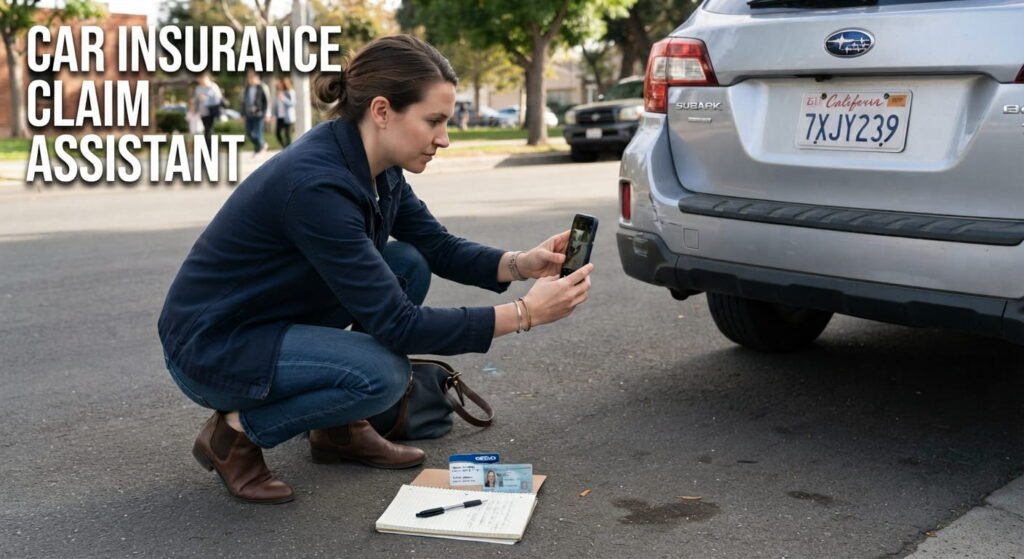
Exchange names, contact details, insurance information, license plate numbers, and vehicle descriptions with the other drivers. If it is safe, photograph vehicle positions, visible damage, traffic signs, road conditions, and the wider scene. Ask witnesses for contact information. Stick to factual observations rather than arguing or guessing about who was at fault.
Seek medical attention if you may be injured, even if you initially feel able to continue with your day. Some injuries are not obvious at the scene. Follow applicable state reporting rules and keep any instructions or records you receive. You can gather additional documents later; you cannot recreate an unsafe scene just to take another picture.
Step-by-step: How to file a car insurance claim after an accident
Once everyone is safe, this accident claim checklist can help you begin the car insurance claims process:
- Review your policy. Find the policy number, claims contact details, relevant coverages, collision deductible, and instructions for reporting an accident. Note whether you have rental reimbursement, medical-related coverage, or other benefits that might apply.
- Notify your insurer promptly. Many companies accept reports by phone, website, mobile app, or through an agent. Describe what happened and ask whether your policy requires anything further, even if you expect the other driver’s insurer to pay.
- Give accurate accident details. Provide the date, time, location, vehicles, drivers, observed damage, and a factual account. Distinguish what you personally saw from what someone else told you. If you do not know an answer, say so rather than guessing.
- Submit available evidence. Provide photos, witness details, police-report information, repair estimates, and relevant medical or towing records as requested. You can ask how to submit a document that is not available yet.
- Record the claim reference. Save the claim number, representative’s name and contact details, and the date you reported the loss. Ask what happens next and whether the insurer needs to inspect the car before repairs.
- Cooperate and keep a file. Respond to reasonable information requests, retain copies of what you send, and make dated notes of calls and decisions. Ask for explanations in writing when a coverage or payment decision is unclear.
Reporting a crash is not the same as an insurer agreeing that a particular loss is covered. Ask which coverage the company proposes to use, whether a deductible applies, and whether you are also making a claim against another driver.
Documents needed for a car insurance claim
You may not have every document on the first day. Start a folder—digital or paper—and add information as it becomes available. Commonly requested items include:
- Your insurance card, policy number, and contact information.
- Your driver’s license, vehicle registration, and vehicle identification number (VIN), if requested.
- The crash date, time, exact location, and a brief factual account.
- Other drivers’ names, contact and insurance details, license plates, and vehicle descriptions.
- Original scene photographs or video showing damage, road conditions, signs, and vehicle positions.
- Witness names and contact information.
- The officer’s details and police or incident report number, if available.
- Repair estimates and invoices, plus towing, storage, and rental receipts.
- Medical records or bills relevant to an injury claim, when requested.
- Loan or lease information if the damaged vehicle is financed or leased.
The insurer may need different records for a small collision repair, a total loss, or an injury claim. Preserve original files where possible. Do not alter images, fabricate evidence, exaggerate a loss, or submit an estimate as if it were a paid invoice. If you later remember a relevant detail or find another document, tell the claims representative.
Working through the claim
Your insurer or the other driver’s insurer?
A first-party claim is made under your own policy. Depending on the crash and what you purchased, you might use collision to address damage to your car, or applicable PIP, medical payments, or uninsured motorist coverage for eligible losses. Comprehensive generally addresses specified non-collision events; it is not the usual coverage for damage caused by a crash with another vehicle. A collision deductible commonly applies if you claim for your car under your own collision coverage.
A third-party claim seeks payment through another driver’s liability insurer. That company typically investigates its policyholder’s coverage and responsibility before accepting and valuing your claim. Its decision may be affected by disputed facts, exclusions, or the driver’s policy limits. You should not assume it will immediately authorize repairs because the other driver apologized at the scene.
You may still need to notify your own insurer under your policy’s reporting terms, even when another driver appears responsible. If you use your own collision coverage while responsibility is being sorted out, ask how the deductible will be handled and whether your insurer intends to pursue reimbursement. Which route is practical depends on the available coverages and the claim; neither guarantees a particular settlement.
What happens after you report the claim?
An insurer will ordinarily acknowledge the report and assign a claims representative or adjuster. The representative reviews the policy and initial account, then may request photographs, statements, police information, witness details, or records from other drivers. An insurer can also arrange an in-person vehicle inspection or assess damage using submitted photos.
Next comes the damage assessment. The insurer may compare its estimate with a repair shop’s, ask for more information about hidden damage discovered during repairs, and determine which losses are covered. It then explains its decision and, if payment is due, how the deductible, limits, valuation, and any other relevant terms affect the amount. Payment may go to you, a repair facility, or an eligible lienholder depending on the settlement arrangements.
Injuries, multiple vehicles, disputed responsibility, extensive damage, or an unclear policy issue can make investigation more involved. Keep a running log of contacts, documents submitted, inspection dates, and promised next steps. If the car is at a storage facility, promptly ask who is responsible for ongoing charges while decisions are pending. Do not assume a repair estimate by itself represents the final claim payment.
What does an insurance claim adjuster do?
An insurance claim adjuster reviews the circumstances and evidence and assesses the loss for the insurer or under an independent assignment. Their work may include inspecting vehicle damage, reviewing repair estimates and records, examining coverage and responsibility questions, and communicating what additional information is needed. The adjuster’s findings inform the settlement, but policy wording, applicable law, and the full evidence also matter.
You can ask the adjuster which coverage is being used, whether the estimate includes all known damage, and how the proposed payment was calculated. If a shop finds additional crash-related damage, ask how to submit a revised estimate before assuming it will be approved. Request a written explanation when you disagree with a valuation or coverage decision, and keep your supporting documents.naic
How a deductible affects payment
An insurance deductible is the portion of an eligible claim assigned to you under coverage that has one. Collision and comprehensive commonly have deductibles; a standard liability claim against your own bodily injury or property damage liability coverage generally works differently. Your declarations page should show the amounts selected for your vehicle.
For an illustrative collision claim, suppose the approved covered repair amount is $3,000 and your deductible is $500. Assuming no other adjustment applies, you are responsible for $500 and the insurer pays $2,500. This does not necessarily require paying $500 to the insurer before repairs start: a shop may collect your portion, or a claim check may have the deductible subtracted.
Your collision deductible may apply even if you believe another driver caused the crash. Your insurer may later seek recovery from the responsible party through subrogation, potentially allowing reimbursement of some or all of your deductible. Recovery is not guaranteed. The final payment still depends on approved damage, coverage terms, valuation, exclusions, and any applicable limits.
Timing and settlements
How long does a car insurance claim take?
There is no reliable nationwide deadline for settling every auto claim. A relatively straightforward vehicle-damage claim can progress differently from one involving injuries, contested fault, several drivers, a total loss, or complex repairs. Police-report availability, inspections, documentation, parts, repair-shop schedules, and additional investigation can all affect the process.
States also have claim-handling rules, but their notice, response, and decision requirements differ. Do not mistake a rule from another state for a deadline governing your claim. Ask your representative what stage the claim is in, what information is outstanding, the anticipated next step, and which state-specific deadlines apply. Follow up in writing if updates are unclear or repeatedly delayed.
Repair completion is not necessarily the same as claim settlement. A shop may need more time after the insurer makes a coverage decision, while an injury claim may remain open as treatment and records develop. Keep receipts and correspondence organized throughout. If you believe an insurer is causing an unreasonable delay, your state insurance department can provide guidance about its complaint process.
What if your car is a total loss?
An insurer may declare a vehicle a total loss when the damage and applicable rules make repairing it uneconomical. The calculation can involve repair costs, the car’s pre-loss value, salvage considerations, policy wording, and state requirements. Ask for the valuation report rather than assuming “totaled” means the insurer will pay what you originally spent.
A standard total-loss settlement is often based on actual cash value—the vehicle’s value immediately before the loss—rather than the price of a new replacement. Compare the report’s year, trim, mileage, equipment, condition, and comparable vehicles with your own records. An applicable collision or comprehensive deductible may reduce a first-party payment. State rules may also affect valuation and certain fees.
If you owe money on the car, the loan or lease balance can exceed its insurance settlement. Eligible gap coverage, if you purchased it, may address some of that difference under its own limits and exclusions. Contact your lender or lessor about the claim, and ask the insurer how payment will be issued. If details in the valuation are wrong, provide evidence and request a revised explanation.
If a claim is denied or undervalued
First, request the insurer’s decision and reasons in writing. Identify the policy provision, exclusion, estimate, or valuation it relied on. Then compare its account with your photographs, repair-shop findings, receipts, police information, and vehicle details. Ask how to submit missing evidence or request another review.
Keep copies of everything and a dated timeline of calls and messages. Ask whether the policy or insurer offers an internal review or dispute process, and read any proposed settlement or release before signing it. A disagreement about a repair amount is different from a denial based on an exclusion, so focus your response on the stated reason.
If you cannot resolve the matter, contact your state department of insurance for consumer guidance or to file a complaint. The department can review certain concerns about delays, denials, communications, or compliance with state insurance rules, but a complaint does not guarantee a higher settlement. For substantial injury losses or complex responsibility disputes, consider qualified legal advice about your options and deadlines.
Common claim mistakes to avoid
Promptly report the accident as your policy requires, even if all documents are not yet available. Preserve photos, estimates, and receipts; avoid guessing when giving statements or presenting uncertain details as facts. Respond to reasonable information requests and document conversations with the insurer.
Before authorizing extensive repairs, ask whether an inspection or other claim step is needed; do not delay necessary safety measures solely to preserve an estimate. Never assume all damage or rental expense is covered. Review the proposed payment calculation and any document that releases a claim or authorizes repairs before signing. Policy and state requirements vary, so ask the representative to explain unfamiliar instructions.
Frequently asked questions
How soon should I report a car accident to my insurer?
Notify your insurer promptly and check your policy for its reporting requirements. You can report the basic facts before a police report or final repair estimate is available; ask how to provide additional records later. Prioritize emergency care and safety first, then record when and how you reported the crash.
Do I need a police report to file a claim?
Not for every claim. State reporting rules, the accident’s circumstances, and insurer requests differ. A report can be valuable evidence, particularly when injuries or disputed facts are involved, but an insurer may begin reviewing a claim before the report is available. Check local requirements and provide its number if one exists.
Will filing a car insurance claim raise my premium?
It might, but there is no universal result. Fault, claim type, prior claims, state rules, insurer rating practices, and any applicable accident-forgiveness provision can affect future pricing. Reporting an incident and receiving a claim payment are also distinct steps. Ask your insurer how it handles renewals rather than assuming a fixed increase.
Can I file a claim if the accident was not my fault?
Yes. You may seek payment from the other driver’s liability insurer or use applicable coverage under your own policy. The other insurer may investigate before accepting responsibility; using your own collision coverage can involve a deductible, with possible—but not guaranteed—later recovery. Notify your insurer as your policy requires.
Should I repair my car before an insurance inspection?
Coordinate with the insurer before committing to extensive repairs, especially if it requests an inspection or photographs. You may need to prevent further damage or make the vehicle safe; keep evidence and receipts for any necessary immediate action. Ask how additional damage discovered during repairs should be documented and reviewed.
What if the other driver has no insurance?
Tell your insurer and ask which of your coverages may apply. Depending on your state and policy, uninsured motorist coverage may address eligible losses, while collision coverage may help pay for damage to your car subject to its deductible. Other remedies may exist, but collecting from an uninsured driver is not assured.
Can I dispute a car insurance settlement?
Yes. Request a written calculation and explanation, check the policy, and submit relevant photographs, repair estimates, receipts, or corrected vehicle information. Ask about the insurer’s review process. Your state insurance department may help with a complaint about claim handling, although neither a review nor a complaint guarantees a different payment.
Conclusion
Knowing how to file a car insurance claim after an accident starts with protecting people, then preserving accurate information. Exchange details, document the scene when safe, notify your insurer promptly, retain claim records, cooperate with the investigation, and review any settlement before accepting it. Coverage terms, state rules, responsibility findings, deductibles, and the damage assessment will shape the result.
Prepare before you need to make a claim: keep your insurance information accessible and know your collision deductible and claims contact options. After an accident, ask questions whenever the next step or payment calculation is unclear. Review your policy now and save a claim-document checklist where you can find it quickly.